
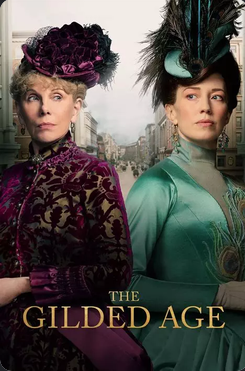

New York, 1882. Just like America, the city is booming. Anything is possible for those who are willing to take risks. And that frightens more than a few people, starting with “native-born” New Yorkers, whose family roots date back to the conquest of the East Coast. Agnès Van Rhijn, a wealthy widow proud of her ancient lineage and the traditions she follows to the letter, watches with apprehension as her neighbors, the Russells, arrive.
Starting from nothing, George Russell amassed a considerable fortune by investing in the railroad, which was still in its infancy. A visionary and a ruthless businessman, he intends to expand his business here. He relies on his wife and closest ally, Bertha. Born into a poor family of farmhands, Bertha is willing to do anything to make her mark in the highest echelons of society. But the doors to the aristocracy don’t open so easily, even when you’re very wealthy.
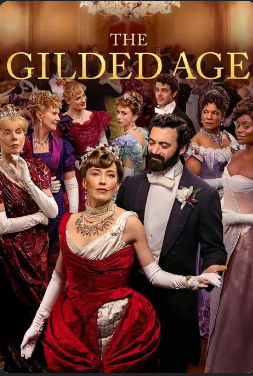
For fans of romance—or, failing that, for the costumes and the history of New York
Following Downton Abbey (and The English Game as well), Julian Fellowes returns to his favorite theme: the lives of the upper classes—amidst drama, romance, and ambition—at the turn of the 20th century, and those of their servants.
The plot here is a bit more fast-paced and gripping. There are way too many romantic subplots for my taste, but I’m not the target audience. I also found the connection between the main narrative arc and Peggy Scott’s story to be rather contrived. The focus on a little-known fact—wealthy Black people shortly after emancipation—is commendable, but it feels like a forced addition to the rest of the story.
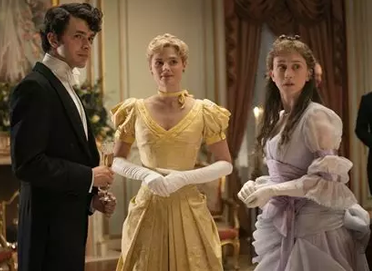
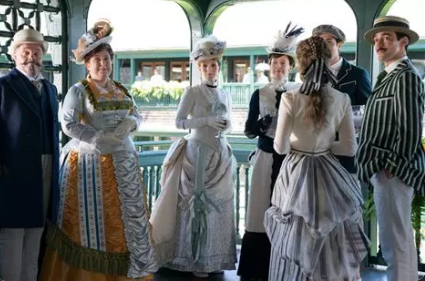
That said, the series has some real strengths. Its costumes, of course, a few fairly compelling characters, a great cast, and above all—at least for me—the historical aspect of the transition to modernity. I loved seeing the industrial and financial mechanisms at work, the stakes involved, and the psychological and economic impact across the various social strata that are pitted against one another. In a world where anything is possible, traditions are fading, but even the winners must face new challenges. Everyone aspires to enjoy the benefits of modernity: workers, Black people, and even women!
While the plot and pacing of The Gilded Age are quite conventional, I think the show is most valuable for its truly fascinating historical backdrop.
3 seasons, 25 episodes (60 mn), 2022- ,on HBO
Created by Julian Fellowes, WITH :
- The Russell family: Carrie Coon as Bertha, Morgan Spector as George, Taissa Farmiga as Gladys, Harry Richardson (Poldark, Not suitable for work) as Larry, Ben Lamb as Hector Vere, 5th Duke of Buckingham
- The Brooks, relatives and friends: Louisa Jacobson as Marian, Christine Baranski (The good wife) as Agnes, Cynthia Nixon (Sex & the city) as Ada, Blake Ritson as Oscar, Kelli O’Hara as Aurora Fane, Robert Sean Leonard (House) as Luke Forte (season 2)
- The servants: Jack Gilpin as Mr. Church, Simon Jones as Mr. Bannister, Ben Ahlers as John “Jack” Trotter, Kristine Nielsen as Mrs. Bauer, Celia Keenan-Bolger as Mrs. Bruce, Douglas Sills as Monsieur Baudin, Debra Monk as Mrs. Armstrong, Michael Cerveris as Mr. Watson, Taylor Richardson as Bridget, Erin Wilhelmi as Adelheid
- the Scott family and friends: Denée Benton as Peggy, Audra McDonald as Dorothy, John Douglas Thompson as Arthur, Sullivan Jones as T. Thomas Fortune, Jordan Donica as Dr. William Kirkland
- Others: Amy Forsyth as Carrie Astor, Nathan Lane (Only murders in the building, Mid-century modern) as Ward McAllister, Ashlie Atkinson as Mamie Fish, Claybourne Elder as John Adams (seasons 1-3), Jeanne Tripplehorn as Sylvia Chamberlain (season 1), Thomas Cocquerel as Tom Raikes (season 1), Katie Finneran as Anne Morris, Ward Horton (The night agent season 3) as Charles Fane (season 1-3), David Furr as Dashiell Montgomery (season 2)
- Businessmen: Patrick Page as Richard Clay, Bill Camp as J. P. Morgan (season 3)
- Guests: Merritt Wever (Unbelievable) as Monica O’Brien (season 3)